

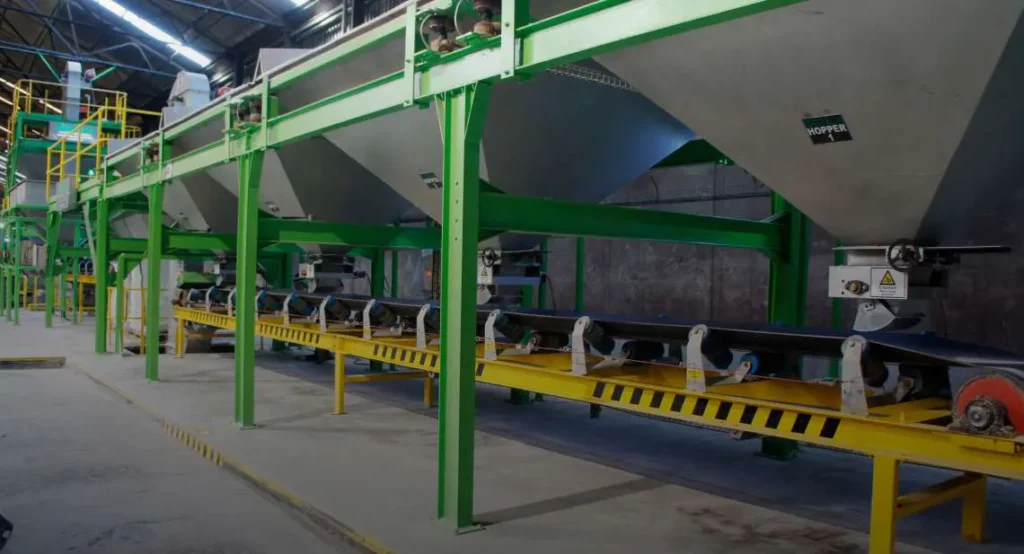
Building a high-performing fertilizer blending plant is not just about combining nutrients. It is about precision, consistency, and reliability at every stage of production. As fertilizer markets become more competitive and customers demand tailored nutrient solutions, the equipment inside a fertilizer blending plant plays a decisive role in product quality and profitability. Among all components, batching systems and mixers stand out as the true backbone of efficient blending operations. Understanding how they work and how they differ is essential for anyone planning or upgrading a modern facility.
Why Equipment Choice Matters in a Fertilizer Blending Plant
A fertilizer blending plant operates on a simple principle: different raw materials must be combined in exact proportions to meet specific agronomic formulas. However, achieving that consistency at scale is far from simple. Inaccurate batching or poor mixing leads to uneven nutrient distribution, customer complaints, and wasted materials.
The right equipment ensures that every batch leaving the fertilizer blending plant meets quality expectations. Experienced engineering brands like Cementl focus heavily on equipment matching, because even the most advanced plant layout cannot compensate for poorly selected batching systems or mixers.
Understanding Batching Systems and Their Role
Batching systems are responsible for measuring and feeding raw materials into the blending process. In a fertilizer blending plant, accuracy at this stage determines the success of the final product. Even small deviations can result in nutrient imbalance and reduced fertilizer effectiveness.
Modern batching systems range from manual and semi-automatic designs to fully automated, computer-controlled solutions. Automated batching is increasingly preferred in a fertilizer blending plant because it improves consistency, reduces labor dependency, and allows fast recipe changes. Cementl designs batching systems that integrate smoothly with plant control software, ensuring stable feed rates and reliable weighing performance.
Another key factor is material compatibility. Different fertilizers flow differently, and batching systems must be designed to handle varying particle sizes without clogging or segregation. A well-engineered fertilizer blending plant takes this into account from the start.
Mixers: The Heart of Uniform Blending
If batching systems control accuracy, mixers control uniformity. Mixers are where the real transformation happens in a fertilizer blending plant. Their job is to ensure that all nutrients are evenly distributed so every bag or bulk shipment delivers the same performance in the field.
There are several mixer designs used in fertilizer blending plant operations, each with its own strengths. Some mixers are better suited for granular materials, while others handle powders or micronutrients more effectively. The key is matching mixer type to product requirements and production volume.
Cementl emphasizes mixing efficiency over brute force. Their mixer designs focus on achieving uniform blends in shorter cycle times while minimizing material degradation. This approach improves throughput and reduces wear, which is critical for long-term operational stability in a fertilizer blending plant.
Batching Systems vs Mixers: How They Work Together
Batching systems and mixers should never be viewed in isolation. In a well-designed fertilizer blending plant, they operate as a coordinated system. Accurate batching feeds the mixer correctly, while an efficient mixer ensures that accuracy is preserved throughout the blending process.
Problems often arise when these components are mismatched. For example, a high-precision batching system paired with an inefficient mixer still results in inconsistent output. Cementl addresses this by designing complete systems rather than standalone machines, ensuring every fertilizer blending plant functions as a unified production line.
Automation and Control Integration
Automation is becoming standard in modern fertilizer blending plant design. Integrated control systems allow operators to monitor batching accuracy, mixing time, and overall production performance in real time. This not only improves quality but also simplifies training and reduces human error.
A fertilizer blending plant equipped with automated batching and mixing can quickly adapt to changing market demand. Cementl’s solutions are built with this flexibility in mind, allowing operators to switch formulations without downtime or complex recalibration.
Long-Term Performance and Maintenance Considerations
Durability and maintenance are often overlooked during equipment selection, yet they have a direct impact on profitability. Equipment downtime can disrupt supply chains and damage customer relationships. A reliable fertilizer blending plant uses equipment designed for continuous operation and easy servicing.
Cementl focuses on robust construction and accessible maintenance points, helping plant operators reduce downtime and extend equipment life. This long-term reliability is one of the reasons their equipment is commonly chosen for high-demand fertilizer blending plant projects.
Conclusion: Choosing the Right Core Equipment
The success of a fertilizer blending plant depends heavily on its batching systems and mixers. Accurate batching ensures precise nutrient ratios, while efficient mixing guarantees uniform product quality. Together, they form the core of any reliable blending operation.
By selecting well-matched, high-quality equipment and working with experienced providers like Cementl, operators can build a fertilizer blending plant that delivers consistent performance, strong customer trust, and sustainable profitability. In an industry where precision defines success, the right equipment makes all the difference.
